



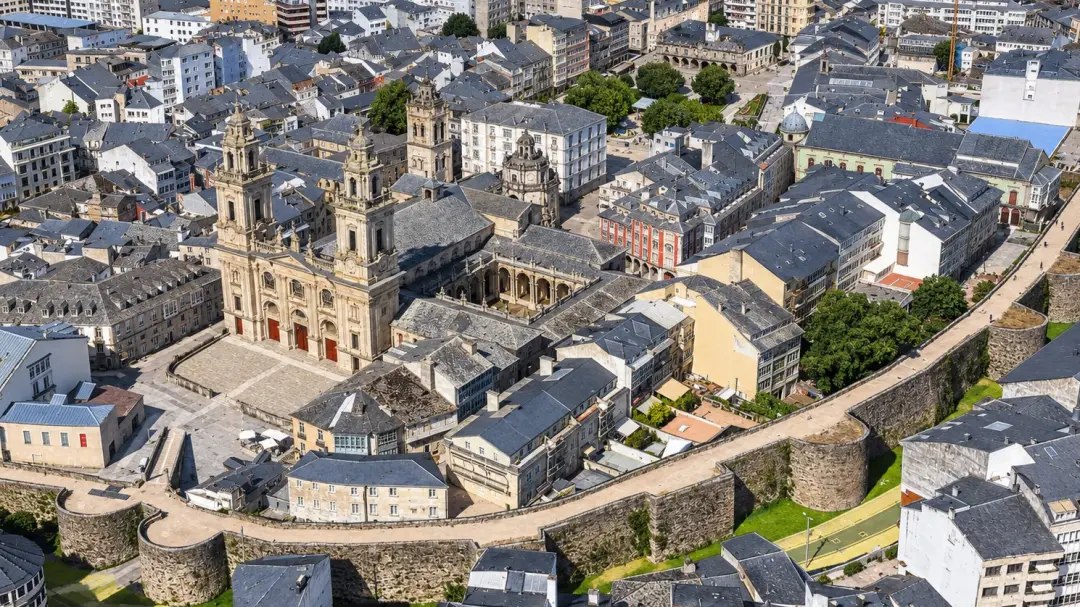
Under the arch of the Porta Miñá your footsteps sound deeper, as if the stone were answering back. That wall has encircled Lugo for seventeen centuries without ever shutting it in: instead, it has kept safe whatever each era left inside. On this walking route we cover the stops you shouldn't miss, and if you'd like to explore them as a game, the escape room in Lugo by Escapeo, “The Echo of the Walls”, turns the walk into an exercise in listening.
What to see in Lugo: what the walls preserve
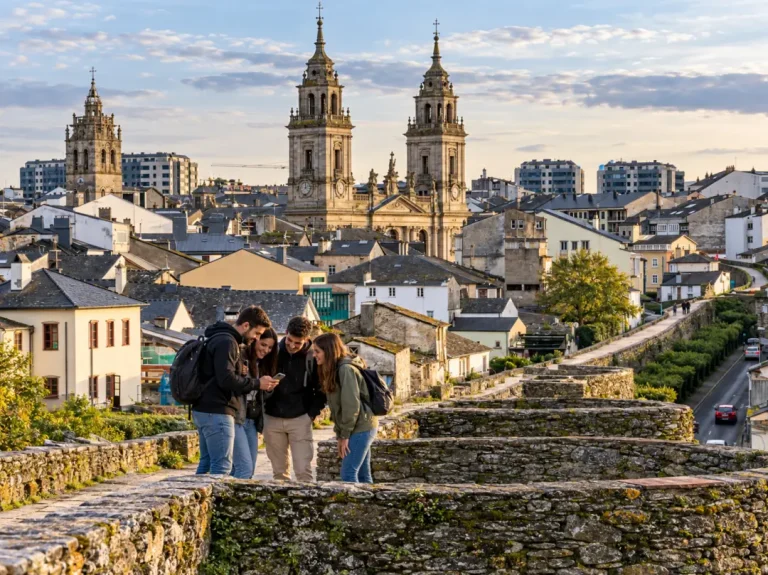
The route starts in Pío XII Square, opposite the Cathedral, and ends in the Main Square. It covers about 2 kilometres and eight stops inside an enclosure with a 2,117-metre perimeter that still keeps 71 of its 85 towers.
What remains of Lucus Augusti: the Domus do Mitreo and the Porta Miñá
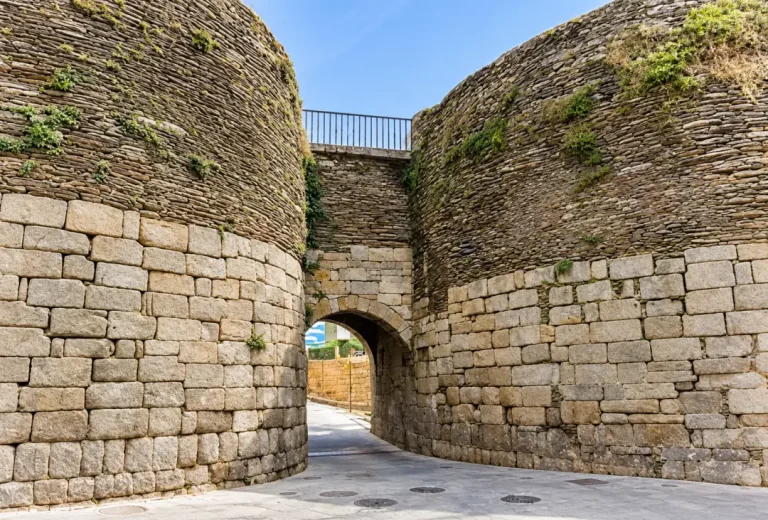
Lugo was born as Lucus Augusti, the sacred grove of Augustus, and the most tangible proof of it is right at the starting point. A 1st-century Roman house, with a porticoed courtyard and wall paintings, was discovered beneath the Universidade de Santiago building on Pío XII Square. In the early 3rd century its owner, a centurion of the Legio VII Gemina, set aside a room for the cult of Mithras. Shortly afterwards, when the wall was built, part of the house ended up beneath its foundations: protecting the city meant sacrificing a piece of it. Today it is the Domus do Mitreo museum. The Porta Miñá, one of the original Roman gates, is a reminder that pilgrims on the Camino Primitivo entered the city here.
What faith holds: the Cathedral, Santo Domingo and San Francisco
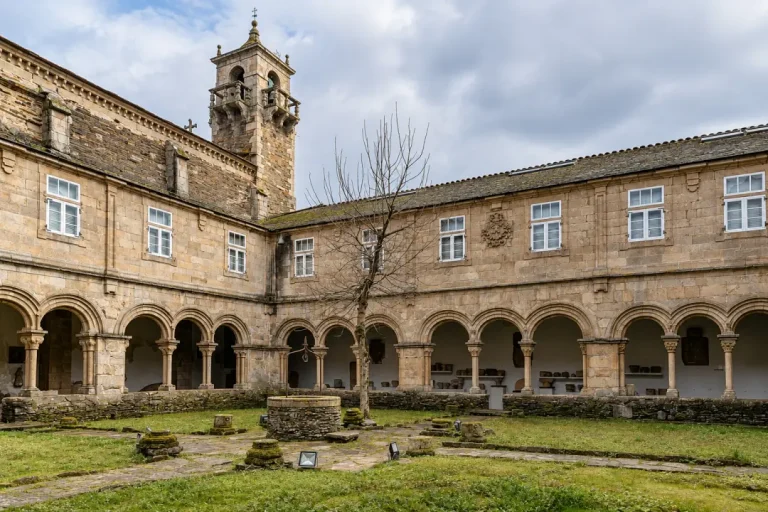
The Cathedral of Santa María was begun in Romanesque style in the 12th century and kept growing for six hundred years, until its main façade was finished in neoclassical style: a building you read in layers. Nearby, the church of the former convent of Santo Domingo presides over a square that hosted fairs and markets for centuries. And the convent of San Francisco, now the Provincial Museum, keeps its Gothic cloister surrounded by Roman sculptures and traditional pottery. Three religious houses that ended up holding much more than faith.
What remains alive: Campo Square, San Marcos and the Main Square
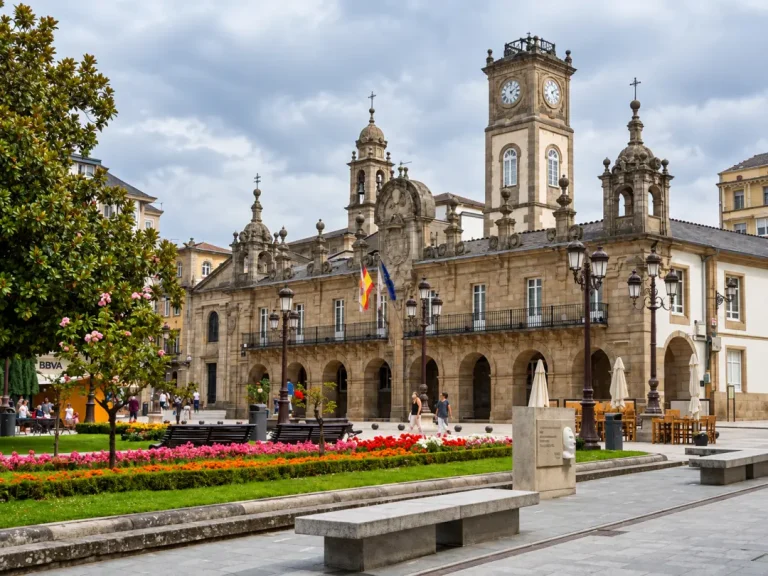
Campo Square stands on the site of the old Roman forum and has never stopped being a meeting place. Its 18th-century fountain has a legend of its own: it is said to have flowed with wine during certain festivals. The Pazo de San Marcos, seat of the Provincial Council (Deputación), hosts both official events and exhibitions. And the Main Square, laid out when the city began to outgrow its Roman layout, is presided over by the Baroque City Hall with its clock tower. It is the square of café terraces and meet-ups: the part of Lugo that isn't in any museum.
“The Echo of the Walls”: the route turned into a game
The story follows a visitor who arrives in Lugo convinced that walls divide, and ends up thinking the opposite. There are eight locations between Pío XII Square and the Main Square, and at each one a fragment of the city becomes a challenge. You don't need to know Latin: you need to look, connect what you see with what you're told and, now and then, decipher. What happens at each stop stays out of this post, for obvious reasons. All we can reveal about the ending is that you leave with the habit of listening to the stone. Play in Lugo at your own pace, with no guide and no set schedule.
Why Galicia's coat of arms has a chalice
On the Cathedral's high altar, the Blessed Sacrament has been on display day and night for centuries. No other cathedral holds that privilege, hence the nickname Cidade do Sacramento. Tradition links this devotion to the chalice and host on the Galician coat of arms. Every year, after Corpus Christi, one of the ancient cities of the Kingdom makes its offering. If you go in, keep your voice down: there is always someone keeping vigil.
How it works and how long it lasts
- All you need is a phone with a data connection: you play straight from your browser, with no app to download.
- When you buy, you receive a code by email. You can pick a date and time, with the team on hand to help you, or play on your own, whenever you like.
- The challenges unlock by geolocation when you reach each spot. Play solo or as a team, with your phones synced and a final leaderboard.
- It takes about an hour on average, with no strict time limit. If you get stuck, hints are available at the cost of a time penalty.
- Comfortable shoes, plenty of battery, and paper and pen. Information and bookings.
Short detours worth taking
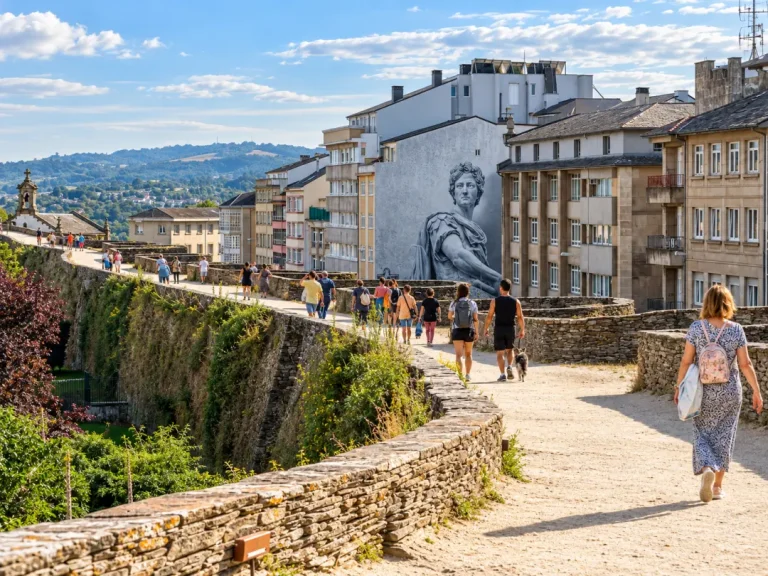
Climb up to the wall walk: walking along the top of the wall is free, it circles the whole city in just over two kilometres and shows you from above what the game makes you look at from below. To understand how it was built, stop by the Wall Interpretation Centre. And if you have the afternoon free, leave through the Porta Miñá towards the Miño: about twenty minutes away you'll find the Roman Bridge of Lugo and the remains of the thermal baths next to the spa.
When to do the route
Lugo is a city of fog: on winter mornings the route takes on an air of mystery as the mist hides the façades. Afternoons, with low light on the slate, are a better time for an outdoor escape room. Watch out for the big dates: in June, Arde Lucus fills the old town with Celtic-Roman celebrations, and in early October San Froilán draws huge crowds and octopus stalls. Fun, yes; ideal for spotting details, not so much.
A wall that does not enclose
Almost all walls were built to separate an inside from an outside. Lugo's has spent seventeen centuries doing something else: keeping things safe. What remains of a Roman house, an altar whose light never goes out, a Gothic cloister, a square full of café terraces. If you rush through, you'll see stone. If you pay attention, you'll start to hear what it has to say. And if you'd like to discover Lugo this other way, book your place on the escape room in Lugo: The Echo of the Walls.